
Multilingual Reasoning Cascades Need More Context
Arnav Mazumder, Dengjia Zhang, Shuyue Stella Li, Yulia Tsvetkov, Niyati Bafna
Read on arXiv →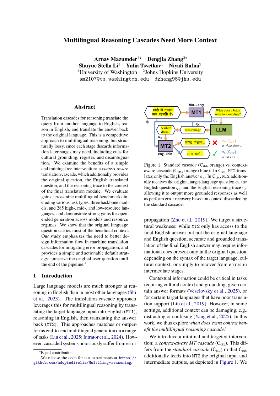
Key claim
Preserving the original question improves multilingual reasoning.
In plain English
Imagine you're building a system that needs to understand and respond to questions in multiple languages. You might think of translating a question into English, processing it, and then translating the answer back. This is a common approach, but it has a big flaw: each translation step can lose important information that might be needed later, like cultural context or specific meanings. This is what's called structural loss, and it can lead to misunderstandings or incorrect answers.
To address this, the authors propose a new method that keeps the original question in the loop throughout the translation process. By doing this, they ensure that the context is preserved, which helps the system make better decisions when generating answers. They tested this approach on nine different multilingual benchmarks, using various models and languages, and found that it led to significant improvements in performance, especially for open-ended questions.
In practical terms, this means that if you're building a multilingual system, you should consider keeping the original user question until the very end of your processing pipeline. This simple change can help reduce errors and improve the quality of the responses your system provides.
The paper introduces a context-aware translation cascade that enhances multilingual reasoning.
The evaluation across multiple benchmarks and models supports the claims made.
Deep reliability assessment
The paper’s training-free modification (feeding qt/qe/re into MT2) is convincingly supported for open-ended, culturally grounded generation across many languages and smaller backbones, with statistical tests and concrete deltas in several cases. Claims about general multilingual reasoning improvements are narrower than they sound: results lean on automatic metrics, mainly show gains for certain task types (and sometimes regress on math), and are demonstrated mostly on smaller open models with limited human evaluation.
Reproducibility
Yes: the authors release code at https://github.com/adoptedirelia/Multiling-reasoning and use public benchmarks (e.g., Aya Evaluation Suite, Global-PIQA, MGSM, MMath). Full reproduction with proprietary GPT-4o-mini is partial, but runs with open models (Llama, Mistral) are reproducible from the repo.
Key figure
Figure 1 contrasts the standard cascade (MT1→English reasoning→MT2 on ae only) with a context-aware cascade where MT2 also receives the original-language question, the English question, and the reasoning trace to enable grounded translation and error recovery.