
CubePart: An Open-Vocabulary Part-Controllable 3D Generator
Yiheng Zhu, Kangle Deng, Jean-Philippe Fauconnier, Inaki Navarro, Daiqing Li, Ava Pun, Yinan Zhang, Peiye Zhuang, Xiaoxia Sun, Maneesh Agrawala, Kiran Bhat, Tinghui Zhou
Read on arXiv →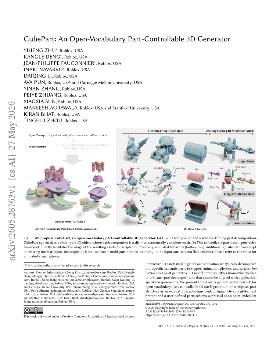
Key claim
Generates 3D meshes with user-defined part structures.
CubePart is a new framework for generating 3D meshes that allows users to specify part structures through a text prompt. This method produces coherent objects that can be directly used in game engines, enhancing the integration of generative models in practical applications. The key result is the ability to generate meshes that respect user-defined semantic structures without manual adjustments.
In plain English
The authors developed CubePart, a framework that allows users to generate 3D models with specific part structures defined by text prompts. Unlike previous methods that produced either solid shapes or random part divisions, CubePart enables precise control over how the model is built, ensuring that each part aligns with user-defined categories. This means that game developers can create 3D assets that are ready to use in their projects without needing to make additional adjustments. Builders should care because this tool streamlines the process of creating interactive 3D content, making it easier to integrate generative models into games and simulations.
The CubePart framework introduces a novel approach to part-controllable 3D mesh generation, significantly extending the capabilities of generative models in this domain.
The claims are supported by a scalable data pipeline and a two-stage generative architecture, though further validation with diverse datasets would strengthen the findings.
Deep reliability assessment
The methodology supports generating part-controllable 3D objects from text prompts, but the scalability and accuracy of part segmentation may be overclaimed due to reliance on VLMs.
Reproducibility
No open source code or dataset is mentioned; reproducibility is limited.
Discussion questions
- 1.How does the reliance on VLMs for part naming affect the accuracy and consistency of the generated parts?
- 2.What are the practical implications for game developers using this tool to generate assets with specific part requirements?
- 3.What evidence would falsify the claim that CubePart can generate semantically meaningful parts for any given schema?
Key figure
Figure 1 illustrates the CubePart framework, showing the process from input prompt to multi-part mesh generation.