
VLK: Learning Humanoid Loco-Manipulation from Synthetic Interactions in Reconstructed Scenes
Yen-Jen Wang, Jiaman Li, Sirui Chen, Takara E. Truong, Pei Xu, Pieter Abbeel, Rocky Duan, Koushil Sreenath, Angjoo Kanazawa, Carmelo Sferrazza, Guanya Shi, Karen Liu
Read on arXiv →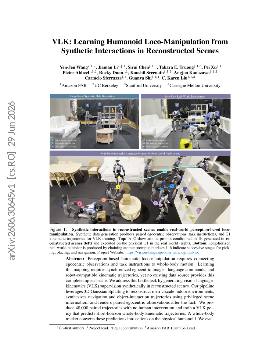
Key claim
Synthetic data enables effective humanoid robot training.
In plain English
Imagine you're trying to build a humanoid robot that can understand commands and navigate its environment like a human. The challenge is that you need a lot of data that connects what the robot sees (like images), what it hears (like instructions), and how it should move (like kinematic trajectories). Currently, gathering this data is tough because it requires a lot of manual work and existing datasets don't cover all the necessary combinations. This is where things can go wrong: without enough diverse data, the robot might not learn to handle unexpected situations well, which is a problem known as data scarcity.
To tackle this, the authors created a system that generates this data automatically. They use a technique called 3D Gaussian Splatting to build realistic indoor environments and then simulate how a robot would interact with these environments based on visual and language inputs. This means they can produce a large number of training examples without needing human intervention. The result is a trained policy that allows the robot to predict how to move in response to commands, which is then tested on a real robot performing tasks like navigating and transporting objects.
Compared to previous methods, this approach significantly increases the amount of usable training data and demonstrates that synthetic interactions can effectively teach robots to perform complex tasks in the real world. For builders, this means you can potentially deploy humanoid robots more quickly and reliably, as they can learn from a rich set of simulated experiences.
The paper introduces a novel method for generating synchronized vision-language-kinematics data at scale, addressing a significant gap in humanoid manipulation research.
The approach is supported by a substantial dataset and practical evaluations on a physical robot, though further validation could strengthen claims.
Deep reliability assessment
The methodology supports the claim that scene-grounded synthetic VLK data can train a Unitree G1 to execute short-horizon navigation and large-object transport when paired with a strong whole-body tracker. It is less clear that the approach generalizes broadly to dexterous manipulation, unseen object categories, cluttered homes, or long-horizon autonomous task completion without prompt chaining and privileged synthetic data assumptions.
Reproducibility
A project page is mentioned, but the provided text does not indicate an open-source code release, dataset release, trained model weights, or exact reconstruction assets. The paper gives useful implementation details such as loss terms, trajectory generation scale, and deployment blur handling, but full reproduction would likely require unavailable 3DGS scenes, synthetic trajectory generation code, tracker implementation, and hardware setup.
Key figure
Figure 1 shows the pipeline from synthetic interaction generation in reconstructed 3D scenes to zero-shot real-world Unitree G1 deployment, including atomic language-conditioned skills and chained long-horizon pick-place-navigation behavior.