
Personal Visual Memory from Explicit and Implicit Evidence
Viet Nguyen, Thao Nguyen, Vishal M. Patel, Yuheng Li
Read on arXiv →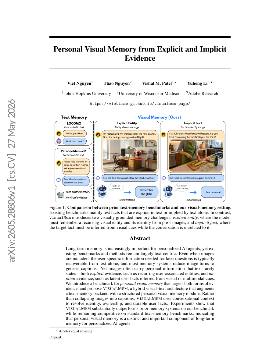
Key claim
VisualMem enhances personalized AI memory with visual context.
The paper presents VisualMem, a new architecture that enhances long-term memory for personalized AI agents by integrating visual information. It shows that using personal visual memory significantly improves performance on a new benchmark while still being competitive on traditional text-memory tasks. This indicates the importance of visual context in personalized AI.
In plain English
The paper presents VisualMem, a new architecture that enhances long-term memory for personalized AI agents by integrating visual information. It shows that using personal visual memory significantly improves performance on a new benchmark while still being competitive on traditional text-memory tasks. This indicates the importance of visual context in personalized AI.
The introduction of a personal visual memory module represents a significant extension of existing memory systems.
The experiments demonstrate substantial improvements over prior systems with appropriate evaluation metrics.
Deep reliability assessment
The methodology supports the claim that structured visual-memory modules can outperform caption-only/text-memory baselines on a controlled synthetic benchmark where visual evidence is deliberately decisive. Claims about real-world personalized agents are less supported because the benchmark appears synthetic, privacy-sensitive real user histories are not evaluated in the provided text, and no quantitative results are shown in the excerpt.
Reproducibility
No explicit open-source code or dataset release is mentioned in the provided text. A project page is provided: https://viettmab.github.io/visualmem-page/
Discussion questions
- 1.Is personal visual memory truly a distinct capability, or can stronger multimodal captioning plus better retrieval close most of the gap?
- 2.For builders, how should agents decide what visual information is worth storing long term without creating privacy, consent, or data-minimization risks?
- 3.What real-world evaluation would falsify the paper’s result: for example, if VISUALMEM fails to outperform caption-based memory on opt-in user photo histories with naturally occurring ambiguity?
Key figure
Figure 1 contrasts text-centric memory benchmarks, where facts are stated or implied in text, with VisualMem’s explicit visual-entity recall and implicit visual-fact inference from images whose accompanying text is unrelated.