
Tiny but Trusted: Efficient Vision-Language Reasoning for Time-Series Anomaly Detection
Xiaona Zhou, Muntasir Wahed, Tianjiao Yu, Constantin Brif, Ismini Lourentzou
Read on arXiv →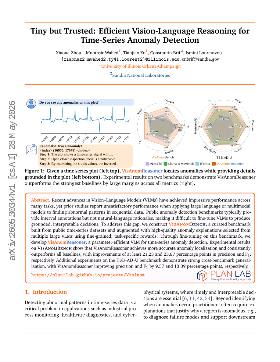
Key claim
VisAnomReasoner achieves significant improvements in anomaly detection.
This paper presents VisAnomBench, a new benchmark for time-series anomaly detection, and introduces VisAnomReasoner, a parameter-efficient VLM that significantly improves anomaly localization. The key result shows improvements of over 21 percentage points in precision and F1 score compared to existing methods.
In plain English
This paper presents VisAnomBench, a new benchmark for time-series anomaly detection, and introduces VisAnomReasoner, a parameter-efficient VLM that significantly improves anomaly localization. The key result shows improvements of over 21 percentage points in precision and F1 score compared to existing methods.
The introduction of VisAnomBench and VisAnomReasoner represents a significant advancement in applying VLMs to anomaly detection in time-series data.
The paper provides strong experimental results across multiple benchmarks, demonstrating solid performance improvements and generalization.
Deep reliability assessment
The methodology supports the claim that a compact VLM fine-tuned on reward-selected, explanation-augmented time-series plots can improve benchmark anomaly localization versus prompted VLMs, foundation time-series models, and classical detectors. The stronger claim that the model is truly 'trusted' or produces faithful explanations is less supported, because explanations are synthetically generated, judged automatically, only partially manually inspected, and may optimize for plausible axis-aware rationales rather than causal diagnostic correctness.
Reproducibility
Partial: the paper provides a project page at https://plan-lab.github.io/projects/VisAnom and introduces the VisAnomBench dataset, but the provided text does not explicitly confirm a GitHub repository, released training code, or downloadable dataset artifacts.
Discussion questions
- 1.Does converting time-series anomaly detection into plot-grounded VLM reasoning actually add robust signal, or does it mainly teach the model to imitate visually plausible anomaly explanations from synthetic labels?
- 2.For builders deploying anomaly detection in industrial, healthcare, or cyber-physical systems, is the gain in interpretability worth the added latency, GPU cost, and risk that generated rationales sound convincing but are not operationally faithful?
- 3.What hidden-domain evaluation would falsify the result: for example, expert-labeled raw sensor streams where non-visual time-series models outperform VisAnomReasoner, or cases where its explanations disagree with domain-causal failure modes despite correct intervals?
Key figure
Figure 1 shows a time-series plot fed to VisAnomReasoner, which outputs step-by-step reasoning plus anomaly tags and index intervals, alongside benchmark comparisons indicating higher performance than VLM4TS, Llama 4 Maverick, and IForest.